Posts
I Just Wanted Blogging to Be a Little Easier
One weekend morning I realized I was done messing with my old Hugo blog.
Nothing wrong with Hugo, honestly. It's fast, it's solid, and as a static site generator it's got pretty much everything you'd ask for. But the longer I used it, the more little things started to grate. Writing a post meant dealing with images. Editing something meant thinking about what it'd do on the other platforms. Want one small new feature? Go dig through config files and templates again. None of it was hard. Stacked up together, though, it slowly killed the urge to write anything at all.
So I flipped the whole thing around: instead of patching it forever, why not build the blog tool I actually wanted to use?
No grand plan this time. I had a free weekend, opened WorkBuddy, and just started talking — what I wanted, what to build, how it looked, what to change. Two days later, the thing that had only been in my head was a system I could actually use.
Looking back, it was a pretty fun couple of days.
Hugo Was Fine. I Just Wanted It to Work My Way.
I'd used Hugo for years and genuinely liked it.
But the more I wrote, the more I wanted. Bilingual posts, image management, publishing to different places, revisions, some basic stats. You can solve every one of those with some tool or other. It's just that each new want came with a little more stuff I had to handle myself.
Sometimes all I wanted was to write one post. Instead I'd be uploading an image, checking the path, fixing the Markdown, and then figuring out where the thing was going to end up.
Keep more than one platform alive and you're doing that whole dance separately for each one.
Small stuff, all of it. But I've learned that small stuff is exactly what decides whether I keep using a tool.
I've got one pretty simple rule for anything I build: it should let me be as lazy as I want.
That doesn't mean doing nothing. It means the tool should eat the repetitive, pointless motions for me.
Upload an image, the path fills itself in. Write a paragraph, the preview is already there. Hit publish, don't make me go read a config file. And sensible defaults belong in the system from day one, not in a dialog box asking me to pick.
When I open it, I want to do the thing I came to do — not spend ten minutes learning how the tool wants me to do it.
So I wasn't after another Markdown-to-static-site blog. I wanted one place that felt easy the whole way through: writing, assets, and getting the post out to wherever it needed to go.
A Whole Weekend of Saying "Nah, Not Quite"
Most of those two days didn't go into figuring out the tech. They went into using the thing and telling the AI, over and over, "this part feels off."
Plenty of first versions worked fine. They just didn't feel right once I actually clicked through them.
Publishing, for example.
The first cut put it in a modal: open it, pick a platform, confirm, done. Nothing broken. I tried it a few times and it still felt like too many steps.
I didn't want a whole extra screen every time I shipped a post. I wanted to find the row in the list, expand the platforms right there, see the state, and publish or pull it back in place.
So we changed it. Again.
Then there was how the three platforms talked to each other.
At first it looked like a checkbox problem: pick where it goes, done. Once I'd actually thought it through, that wasn't it at all.
I wanted them completely independent.
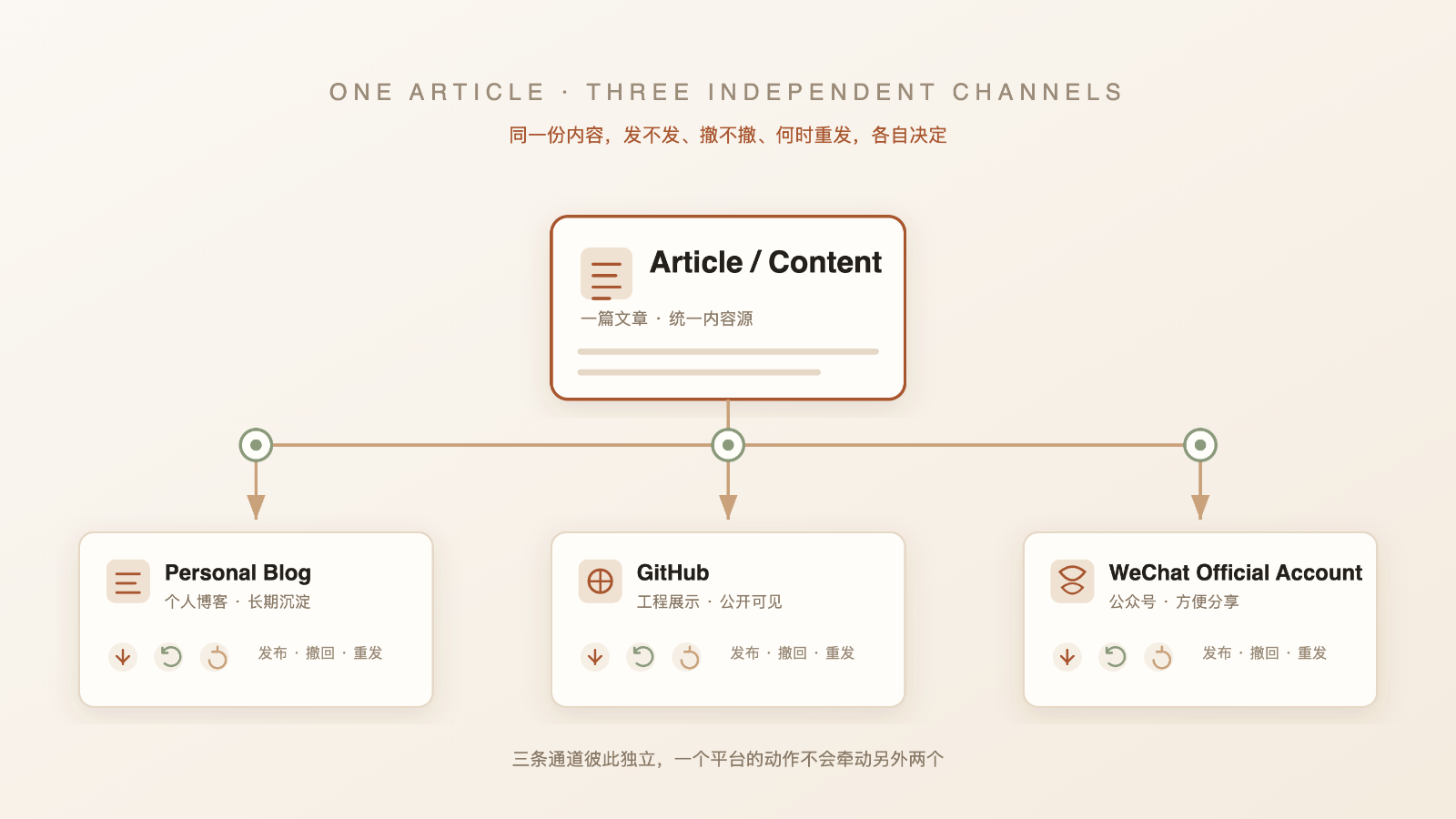
Publishing to my own blog shouldn't drag GitHub along. Pushing a draft to WeChat shouldn't touch what's live on the site. Pull a post from one place and the other two shouldn't even notice. Same for republishing later — each one on its own.
That's not a few more toggles. That's a different publishing model underneath.
A couple of other things still make me laugh.
My resume accidentally made it into a public repo. I added an exclude rule. Then I went to clean the history and found the old commits were still reachable. Ended up having to rebuild the repo to actually get rid of it.
That one taught me not to bet private files on remembering an exclude rule. The default has to be safe on its own: if I didn't explicitly put something there, it doesn't go into the public build.
The migration had a cousin of the same bug. New site was live, but old Hugo URLs still resolved. Turned out the sync only added and overwrote — it never deleted. Switched it to a real mirror and cleared out 198 stale files and 103 empty directories.
None of these were hard engineering problems.
They were real, though. And they're exactly the distance between "the feature exists" and "I'd actually open this every day."
The Best Part of AI Coding Is That You Can Keep Changing Your Mind
One thing hit me pretty hard this weekend.
On a normal side project, I'd spend a lot of time up front deciding the architecture, the stack, the interfaces, the implementation. Plenty of ideas died right there, at the "is this even worth it" stage.
This time was different.
I could just say the idea out loud, let the AI build a version, open it, use it, notice what bugged me, and say so.
Half the time I couldn't even describe the problem properly.
It'd come out as "eh, this looks wrong."
Or "this takes too many clicks."
Or the classic: "No — that's not what I meant."
And we'd keep talking and try another version.
It's not a clean, textbook process. The proper way is to nail the requirements, then design, then build, then test.
For a personal project, though, this suited me better.
Because most of what I wanted only became clear once I was using the thing.
I didn't know the final UI going in, and I hadn't spec'd every feature. Seeing v1 is what told me what I actually wanted.
The AI handled implementation fast, which left me more room for the part I care about: using, judging, and fixing.
It wasn't smooth the whole way. Sometimes it misread me. Sometimes a fix here broke something over there. Some tiny-looking changes took four rounds.
But overall it let me go straight from an idea in my head to real software, then keep shaping it against how it actually felt.
That's probably the biggest takeaway from the weekend.
Three Places, Three Different Jobs
The part I'm happiest with is finally having my blog, GitHub Pages, and a WeChat official account managed from one place.
They do three different things for me.
The blog is mine.
I put whatever I want there — tech, work, stuff I'm learning, life, random thoughts, even a stretch of mood I want to remember. No traffic goals, no worrying about whether anyone likes it. Mostly I want a place where things accumulate over years.
GitHub Pages is the engineering side.
Projects, technical write-ups, architecture notes, code practice. Someone landing on my GitHub should see more than repos — they should be able to tell what I've built, how I think, and how I approach the work.
The WeChat official account is the easy hand-off.
Realistically, people aren't going to open your blog or go dig through your GitHub. But a WeChat article, one link, one QR code — that's a pretty low-friction way for someone to get a read on you.
Maybe it's a place for technical thoughts, maybe just an intro to who I am. I haven't figured out what I'm doing with it long term. For now I just want to put the things I actually mean into decent shape before I send them out.
So no, I don't want the same post copy-pasted three times.
One piece can go to one place or three. Each channel keeps its own state — publish, pull it back, republish later, all on its own.
That's the part I finally got working.
What used to be a pile of separate chores now mostly happens in one place. Once the writing is done, the rest is easy.
Where It Stands Right Now
The system's basically done.
Editing, content, images, multi-channel publishing, the basic site plumbing — it's all in one place. Blog, GitHub, and WeChat are wired up, and so far I haven't hit anything that blocks me.
Under the hood it's React, Go, MySQL, and MinIO, brought up with Docker Compose. Markdown rendering, code highlighting, math, diagrams — all handled. Each platform has its own publish path and its own records, so adding a fourth one later doesn't mean tearing anything apart.
Not everything got finished, though.
I wanted to fold podcast stuff in too, but the local Ollama step was slow enough that it just wasn't fun to use. I left it alone for now.
I didn't feel like shipping a half-good feature just so the feature list looked complete. If the whole point is to make myself comfortable, the uncomfortable parts can wait.
As it stands, it covers pretty much everything I need right now.
When Building Gets Cheap, What I Actually Care About
Finishing this left me with a fairly clear thought.
AI coding really is changing how software gets made.
I used to price out an idea first: what framework, how much code, how much upkeep. If it touched enough pieces, I'd be tired before I wrote a line.
Now a lot of things are worth just trying.
Say it out loud, let the AI stand up a version, open it, use it, then decide what to change. Ideas that used to take forever to validate now show up on screen fast.
But this weekend also made me more sure of one thing: just because something got built doesn't mean it's done.
The AI can spit out a page, implement a feature, wire up a whole system. It has no idea whether that flow matches how I work, whether the button belongs there, or whether a feature that technically runs still annoys me every single time.
That still needs a person to actually use it, feel it, and call it.
Which is basically all I did for two days.
Open a page, click around, find something small, fix it. Some fixes were code, some were just moving an interaction around. Every one of them moved the tool a little closer to the thing I actually wanted.
The cheaper implementation gets, the more I suspect the job doesn't get smaller.
If anything, you need to be clearer on why you're building it, what problem it's actually solving, and whether the result is worth using.
Code comes fast now. Features come fast.
Whether a tool is any good still takes someone living with it for a while to find out.
Write the Post, Then Ship It
One more thing I liked.
This post went through the same pipeline.
I didn't sit down and type it out from line one. I talked through the weekend — what happened, what I was thinking, how it felt — and let the AI organize, structure, and clean up the words.
Then it landed in the blog platform for editing, preview, images, and finally publishing wherever it needs to go.
Which is pretty much the reason I built the thing in the first place.
I'd rather spend my attention on what I'm trying to say than on the same handful of chores.
It used to be: how do I structure this, where do the images go, how's the formatting, and how does it get published.
Now the tool eats most of that.
I just have to say what I mean, then look hard at the result and decide if it's what I wanted.
Two days, one weekend, and something I'd been meaning to build for a long time actually exists.
There's no clever tech in it and it's not going to change the world. But getting an idea out of my head and into a tool I'd actually keep using — that made me pretty happy.
And next time an idea shows up, I probably won't start by estimating how long it'd take.
I'll probably just open WorkBuddy and say it out loud.
Then see what happens.